
Newly appointed army chief Joginder Jaswant Singh will visit Jammu and Kashmir on Friday to take stock of the security situation and counter insurgency operations.
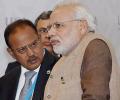
The US has all along interfered in India-China issues. The objective is clear: Bring the Sino-Indian standoff to a flashpoint that would compel Modi government to take shelter under an American umbrella, argues Ambassador M K Bhadrakumar.
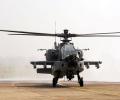
The AH-64E Apache is one of the world's most advanced multi-role combat helicopters, and is flown by the US army.
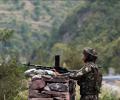
A large population was forced out of their homes due to heavy shelling and firing.

The United States has announced the end of its 20-year-old war in Afghanistan as the last American military flight flew out of the Hamid Karzai International Airport in Kabul shortly before the August 31 deadline.
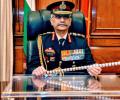
Nepal raised objection to India's newly-inaugurated road linking Lipulekh Pass with Dharchula in Uttarakhand.

Indian Army Chief General Dalbir Singh Suhag will attend an inaugural United Nations conference on peacekeeping operations

'The government will ensure that India's pride is not affected as far as the situation along Indo-China border is concerned'
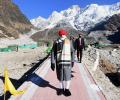
We understand the electoral compulsions, the desperate need for the BJP to have at least 50 per cent of the Hindus vote for them in Uttar Pradesh in a few months. For that, you need polarisation, put your own Muslim compatriots on the 'other' side. This is how your domestic politics runs contrary to your national, strategic interest, warns Shekhar Gupta.

'Galbraith had a powerful ally in Washington -- not as blunt and direct as the ambassador -- but committed to see Krishna Menon go.' 'This was President Kennedy himself.'

The parade began after President Ram Nath Kovind conferred the Ashoka Chakra -- India's highest peacetime gallantry award -- to Lance Naik Nazir Ahmad Wani, a militant-turned-soldier who laid down his life fighting a group of terrorists in Shopian in Kashmir in November.

Army Spokesperson Colonel Aman Anand said troops from China's People's Liberation Army (PLA) 'violated' the consensus arrived at during military and diplomatic engagements on the ongoing standoff in eastern Ladakh, and carried out provocative military movements to change the status quo.
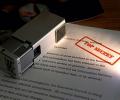
A Naik Subedar with Army was on Wednesday arrested by the Hyderabad police on the charge of sharing information about strategic locations of Army bases and deployment of units with a woman, suspected to be a Pakistani national, through the Internet.

'Had they struck on the night of the 1st, there would have been hell to pay and had they been able to sneak further in, we would have had a greater problem,' says Lieutenant General H S Panag (retd), the former Northern Army Commander.
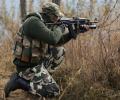
A bench of Chief Justice G Rohini and Justice Jayant Nath issued notice to the Ministry of Defence, saying that "we want to know your response" and listed the matter for hearing on February 3 next year.

'You have been surrounded from all directions, if you want the safety of your troops and your personal safety, we will give you eight hours to make up your mind to surrender.'

Senior commanders of the two armies held intense negotiations for nearly 11 hours on Sunday at a designated meeting point in Moldo on the Chinese side of the Line of Actual Control.
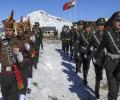
'They also agreed that for the overall development of bilateral relations it was essential to maintain enduring peace and tranquillity in the border areas,' the MEA said in a statement.
'China is mindful of the fact that it is not confronting the Indian Army of 1962. But the sabre rattling will continue.'

>Putin's last-minute intervention with PM salvages $5.43 bn pact.

The Ministry of External Affairs (MEA) spokesperson Anurag Srivastava said complete disengagement requires re-deployment of troops by each side towards their regular posts on their respective sides of the Line of Actual Control(LAC) and this can be done only through mutually agreed actions.

The Indian Army posts strongly retaliated to the firing from the other side.
The Indian delegation at Thursday's talks is likely to be led by Naveen Srivastava, Joint Secretary (East Asia) in the external affairs ministry, they said.
As India's international role expands, so must our capabilities, says Brigadier Gurmeet Kanwal (retd).
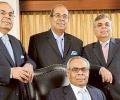
Four Hinduja brothers -- Srichand, Gopichand, Prakash and Ashok -- had in 2014 signed on a document saying the assets held by one brother belong to all, and that each of them will appoint the others as their executors. But now family patriarch Srichand Hinduja, 84, and his daughter Vinoo want the letter to be declared of "no legal effect" and the family's assets be separated as per his wish of 2016.

"Every action we take will be designed to ensure our military is ready to fight today and in the future," Mattis said on Friday in a message to department of defense soon after he was being sworn in as head of the Pentagon by Vice President Mike Pence at the White House.
'The Himmatsinghji Report is still 'missing'.' 'It is a great loss for the knowledge of India's borders.' 'It would have an immense value at a time China is bound to shift its attention to other border fronts in the Himalayas,' notes Claude Arpi.

Adjutant General of the Army Lt General Ashwani Kumar said it planned to induct about 800 women in the military police with a yearly intake of 52 personnel.

'I chose the army over glamour,' says Major Sheena, who feels no other profession elicits the kind of respect like the army does.

India's military prowess and multi-hued images of the country's rich cultural diversity and achievements in various fields were on display at the majestic Rajpath on Tuesday during 67th Republic Day parade which was graced by French President Francois Hollande as the chief guest.
'At this point, neither the army or the IAF has that immediate, punitive deterrent power against Pakistan.' 'Forget a three-week war; on the LoC, where the action is, Pakistan has until now fielded better infantry weapons, body armour, sniper rifles, and matching artillery' points out Shekhar Gupta.

Army Chief Dalbir Singh on Saturday visited the Northern and Western Commands to review India's operational preparedness along the border with Pakistan in the wake of heightened tension between the two countries following the surgical strike at terror camps across the Line of Control.

'What we are actually missing in India is a platform wherein the government engages with cybersecurity experts, gets them employed and then utilises their capability to deter such attacks.'

Parrikar announced that all those seven security personnel killed during the attack will be treated as martyrs that will entitle them to all the benefits available to 'battle casualty' as in war-like situations.

The experts also said China's military 'misadventure' may have been driven in part by President Xi Jinping's attempt to show 'gains somewhere" after the growing global criticism against his country over the origin of COVID-19.

Lt Gen. (retd) Rajendra Nimbhorkar, who carried out surgical strikes, recounts the details.
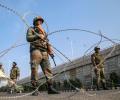
Internal security columns of the army, which were deployed in the curfew-bound areas, were seen staging flag marches, while dozens of persons were taken into preventive custody to maintain law and order.

Pakistan Defence Minister Khawaja Asif has accused India's external intelligence agency Research & Analysis Wing of involvement in "whipping up terrorism" in the country.

'They will try more rounds of military level talks and move it to the diplomatic and political domain to see if there is a possibility of a solution -- and like the CDS said if that does not happen, we are prepared.'
The focus of the deliberations was on finalising modalities for disengagement of troops in eastern Ladakh.
